Patch 0.5.5 moved where Omens of Light come from and did not say so in the notes. Most Abyss advice still describes the old chain, and following it means paying for map modifiers that no longer touch your rewards. This page works through the mechanic as the game describes it, then through what two creators found when they actually counted.
What Abyss actually sells for
Every number here is one reading of the in-game Currency Exchange, taken at the same moment, at 1 div = 7.99 Chaos. Sorted by what they are worth:
| Item | Market ratio | In Divine | Demand queued behind it |
|---|---|---|---|
| Preserved Cranium | 132 Chaos | 16.5 div | 9,750 at 130 |
| Omen of Light | 59 Chaos | 7.4 div | 5,046 at 58 |
| Ancient Jawbone | 52 Chaos | 6.5 div | 3,900 at 50 |
| Ancient Collarbone | 43 Chaos | 5.4 div | 5,292 at 42 |
| Ancient Rib | 40 Chaos | 5.0 div | 3,888 at 36 |
| Kulemak’s Invitation | 33.5 Chaos | 4.2 div | 1,457 at 33 |
Two things stand out. The Cranium is worth about two and a half times the next bone, which is what the rest of this page is built around. And every one of these has thousands of Chaos of demand queued a point or two below the ask — liquid, tight-spread markets, so counting drops really is counting income.
At four to seven Omens per ten maps, the Omens alone are 30 to 50 div per ten maps.
What an Abyss actually does
The in-game description is unusually precise:
An Abyss is a pit which leads deep underground with multiple fissures branching from it. Any monsters spawned near an Abyss will be weakened by it. Defeating these weakened monsters will cause the fissures to close. Once the fissures have closed all the way to the pit, the pit will activate and spawn a large number of Abyssal monsters.
The part that decides your rewards is what you fed it:
The rarity of the monsters spawned depends on the rarity of the slain weakened monsters, and the emerging Abyssal will steal some or all of the modifiers from them. Any of the modifiers stolen by Rare Abyssal can be upgraded to Abyssal Modifiers.
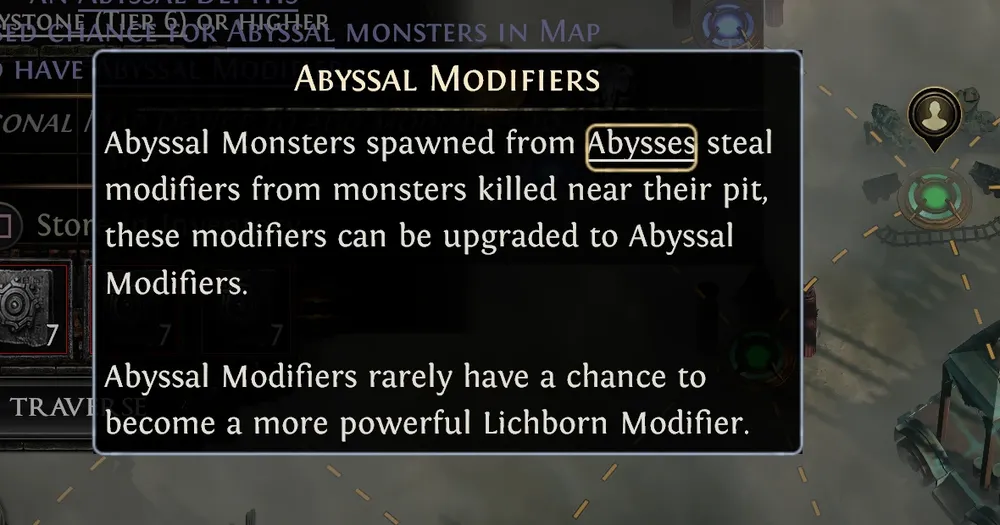
An Abyss does not generate rewards — it converts the monsters you kill beside it. Kill white trash around the fissures and the pit produces weak Abyssals with nothing worth stealing.
There is a technique here that a 100-map test measured: clear the monsters around the pit mouth and follow them, rather than standing at the mouth spamming a skill. Killing Abyssal monsters after pulling them off the fog produced more Omens than the stationary approach.
Only the final Abyss can open a Depths
Guides routinely recommend stacking “additional Abysses” to reach the Abyssal Depths more often. The game’s own wording rules that out:
The final Abyss in the area has a chance to instead open an underground dungeon called an Abyssal Depths.
One roll per map, at the last Abyss you close. Six Abysses give you six Troves and one Depths roll, exactly like one Abyss would.
The 0.5.5 change nobody announced
Swordorin ran 100 maps to test it and came out with a conclusion the patch notes never mentioned: Omens of Light moved almost entirely into the Abyssal Depths. Surface Abyss drops were cut to a trickle while the Depths gives far more than before.
The consequence is blunt: juicing the map for Omens of Light no longer works. What decides your income is how often a Depths opens and how strong your waystone is when it does.
The headline numbers from that test: 534 Divine profit across 100 maps against 117 Divine invested, with a best block of 21 maps producing 15 Omens of Light plus a fracturing orb and a Kulemak imitation.
Two behaviours are worth knowing before you count your own results. Omen of the Leech now drops alongside Omen of Light, which makes it look like you fumbled a pull when you did not. And whether the Depths behaviour is intended or a bug is still unclear — it reproduced both ways in testing, so it may be patched.
Two sources, one of which cares about faction
| Where | Which rares drop Omens |
|---|---|
| Inside an Abyssal Depths | Every rare, whichever faction you run |
| On the surface map | Only rares carrying Amanamu’s void smoke |
That second row is the case for picking Amanamu — it is the only faction that pays Omens outside the Depths. Those rares must be pulled out of the smoke before you kill them or the Omen does not drop.
Kill rares for Omens, open chests for bone
Preserved Cranium, Ancient Jawbone, Ancient Rib and Ancient Collarbone all come from chests, not monsters. That is what makes a Cryptic Key worth carrying — and it is the setup for the section below.
Preserved Cranium: the one actually worth chasing
Every other Abyssal Bone covers a gear slot, and each comes in a three-step ladder:
| Bone | Desecrates | Tiers |
|---|---|---|
| Jawbone | A Rare Weapon or Quiver | Gnawed → Preserved → Ancient |
| Rib | A Rare Armour | Gnawed → Preserved → Ancient |
| Collarbone | A Rare Amulet, Ring or Belt | Gnawed → Preserved → Ancient → Altered |
| Preserved Cranium | A Rare Jewel | one, and only one |
There is no Gnawed Cranium and no Ancient Cranium — it comes in one form, and it is the only bone that touches jewels. But the reason it prices where it does is the plain one: it drops rarely. Supply is what sets it apart from the rest of the board, and the single tier is a symptom of that rather than a cause.
Making it show up more often
The Cranium comes out of chests, so the levers are chest levers, not monster levers:
| Lever | What it does |
|---|---|
| Ghastly Relics | Large Abyssal Chests from Abyss Pits become an Abyssal Strongbox instead |
| Cryptic Key | ”Opens an unopened Strongbox allowing it to be opened an additional time” |
| Mysterious Gifts (Jado) | 5% chance for Rare Strongbox Monsters and 1% for Unique Monsters to drop a Cryptic Key |
| Treasure Coves | 30% increased Magic Chests, 20% increased Rare Chests |
| Strange Aversions | Restructures faction chests — Ulaman currency, Kurgal weapons, Amanamu armour, Basic and Jewellery from any faction |
Ghastly Relics plus Cryptic Keys is the combination. On its own, Ghastly Relics converts your large chests into strongboxes; on their own, Cryptic Keys are a second opening you have nothing good to spend them on. Together, every large Abyssal Chest in the map becomes a strongbox you can open twice, and Mysterious Gifts keeps you supplied with the keys.
Be careful what you pay, and watch for mistakes
Abyssal Bones trade on the in-game Currency Exchange. Searching the trade site for one returns nothing, and that is the wrong window rather than a sign the item is unsold — price these the way you price currency, on the exchange screen.
At 132 Chaos the Cranium sits clear of every other bone on the board above, and the spread is about one Chaos wide with 9,750 Chaos of demand queued at 130.
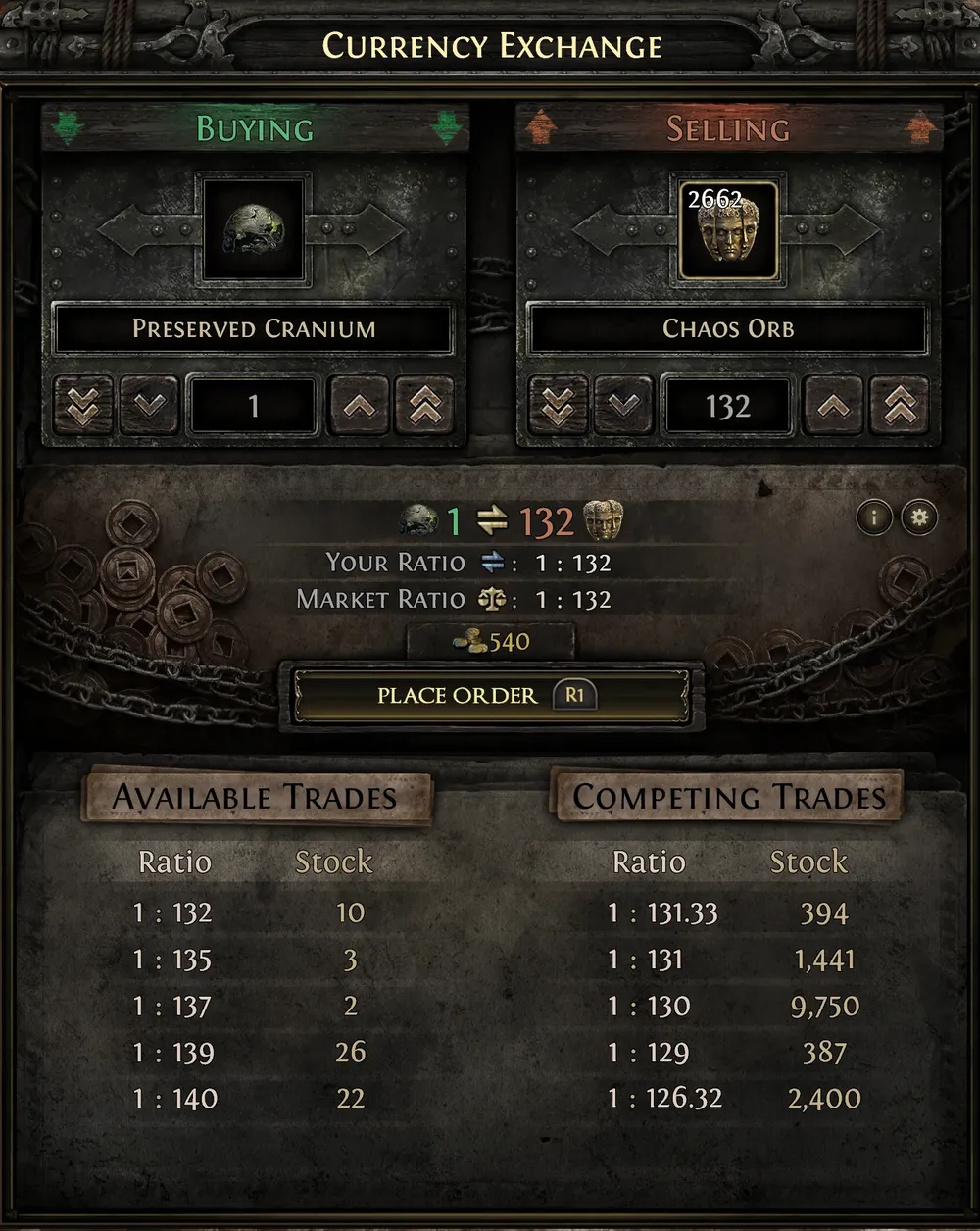
You can convert Craniums to currency the moment you want to, at a price that barely moves.
Which monsters to look for
There are three groups — the Lightless, the Blackblooded and the Legion of the Pit — and an area generally contains only one. The Lightless line below its boss:
| Monster | What it looks like | Where you meet it |
|---|---|---|
| Lightless Abomination | A mass of tentacles | Inside the Depths, and the most frequent Omen source in practice |
| Lightless Moray | Eel-like caster | Inside the Depths |
| Lightless Serpent | Serpent caster | Surface pits |
| Lightless Vengewing | Winged carrion thing | Surface pits |
Counting across a farming session, the Abomination produces the most Omens of the three that drop them — most likely because it is the type you meet most often inside a Depths, not because its rate is better.
Which boss room you get, and why it never changes
| Arena | Boss | Faction |
|---|---|---|
| Lightless Void | Tasgul, Swallower of Light | Lightless |
| Dark Domain | Vandroth, Blackblooded Enslaver | Blackblooded |
Because an area contains a single faction’s monsters, the arena follows the faction. Landing in Lightless Void every run is not a coincidence — it is the faction you are generating. The Atlas keystone Balance of Power lets you “Select the Abyss Faction you encounter in non-Fissure Abysses”, and an Abyssal Fissure is by description “always of a single faction, with the final area leading to that faction’s boss”.
What to roll
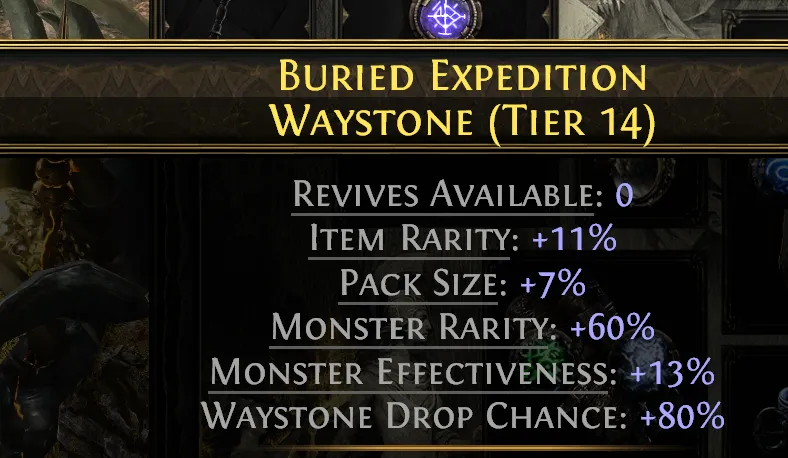
The rule that makes sense of everything else: your waystone’s modifiers buff the Abyssal Depths. That is why waystone strength matters more than map juice — the money is inside, and the waystone is what reaches in.
- Make the waystone as strong as you can. Max rarity, max effectiveness, or a heavily modded base all work — the point is that the modifiers reach inside the Depths, so a strong stone beats a juiced surface.
- Monster Effectiveness pays, despite how it reads. It makes monsters tougher, and it also raises the quantity of items they drop and the experience they grant — reported at roughly 2% toughness for every 1% item quantity and 1% experience. It is a reward stat with a difficulty price, not a pure cost. The Atlas keystone The Journey Ahead offers Pack Size, Effectiveness or Rarity for every monster in your maps, and Effectiveness is the usual pick for exactly this reason.
- The 100-map test measured a 44% Effectiveness waystone performing badly, but over ten maps — far too small to weigh against a stat that multiplies item quantity. Treat it as a note about clear speed rather than about Effectiveness: a stone you kill through slowly costs you Divine per hour even when it raises Divine per map.
- Item rarity on the map is wasted. It buffs the surface, and the surface is no longer where the Omens are.
- Skip Delirium and Sacred Bloom. Both buff the surface only, so adding them is currency spent on nothing.
Tablets
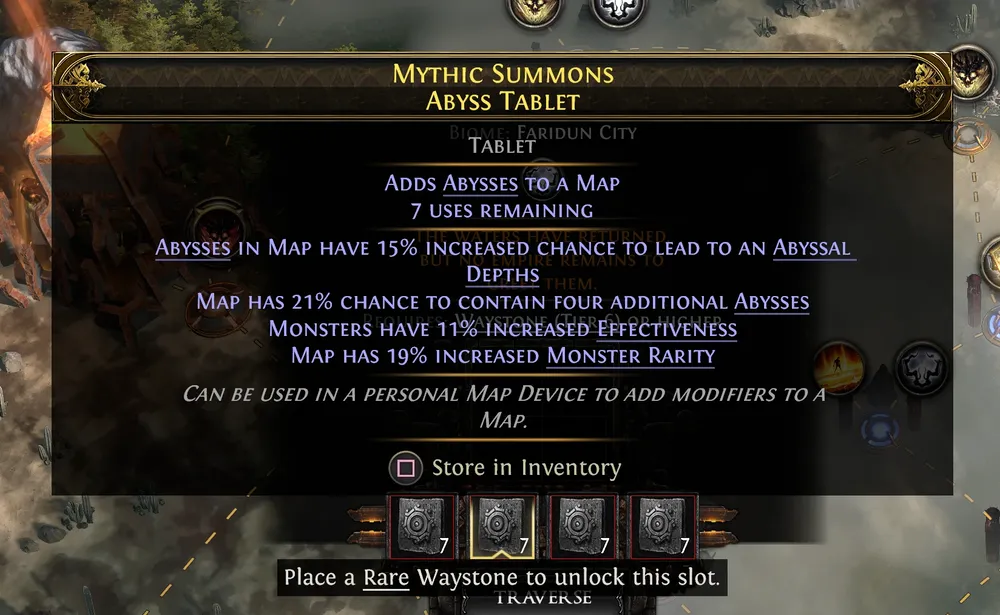
Three Abyss tablets on a cleansed map is the tested setup, and stacking their Depths chance pushes it toward 90%. What you want on them:
| Tablet modifier | Why |
|---|---|
| Chance for Abysses to lead to an Abyssal Depths | The gate. Stack it across every slot |
| Increased Rare Monsters | Rares are the Omen source |
| Increased Monster Rarity | Magic monsters upgraded to rare feed the same target |
| Pack size | Beat increased magic monsters head-to-head in testing |
Run cleansed rather than corrupted. Cleansed adds fracturing orb income and lets you skip the corruption nodes entirely, which otherwise just make the map harder.
Three tablets on a cleansed map, or four on a city map?
There is a genuine fork here, and the two creators land on opposite sides of it.
City maps take a fourth tablet once you have the Atlas notable Industrial Improvements — “An additional Tablet may be used on City Maps”. Four slots instead of three is a quarter more of every tablet stat you care about, Depths chance included, so on paper the city map wins.
The measurement says otherwise. In the 100-map test, city maps produced noticeably worse Depths than three-tablet cleansed maps despite the extra slot. The creator could not explain it and suspected a bug, which means it may also be quietly fixed at some point.
So: cleansed is the tested answer, city is the one that should be better on paper. If you are already running city maps for their layouts or their strongboxes, the fourth tablet is a real gain and worth keeping. If you are choosing purely to see Depths more often, the measured result points at cleansed — and this is a cheap thing to check for yourself over twenty maps each.
Atlas nodes and master
| Node | Effect |
|---|---|
| Close to the Surface | Explicit Modifiers on your Waystones apply to Abyssal Depths — this is what makes a strong waystone reach inside |
| Unholy Influence | 100% increased chance for Abyssal monsters to have Abyssal Modifiers, and the same for Lichborn |
| Dark Bloodlines | Abyss Pits and Cracks have 25% chance to spawn all monsters as at least Magic — better input for the steal |
| Abyssal Ire | 25% chance for Abyssal Depths in Level 78+ areas to contain a Boss |
| Depths Chance | Abysses have 10% increased chance to lead to an Abyssal Depths |
| Shadow of Undeath | 50% increased chance of Lichborn Exiles |
| Armaments of Evil | Tier 5 Rare Equipment from Abyssal monsters carries a Desecrated Modifier |
Take Amanamu, the Omen nodes, and nodes that spread effects across the whole map. Fixed effectiveness nodes are mostly wasted now that map juice does not feed Omens.
For the master, the two creators disagree and it is worth knowing why. Swordorin’s 100-map test runs Doryani, for the node that gives waystones 25% more effect from prefix or suffix modifiers — which follows directly from waystone modifiers buffing the Depths. TheMidTierGamer runs Jado instead, for Unexpected Missions on corrupted maps and Partial Translations for tablet effect, in a build that treats Abyss as one part of a broader map-juice strategy. If your plan is the Depths specifically, Doryani has the tested case and the cleaner mechanism.
Note the level gate on Abyssal Ire: Tier 14 puts an area at level 78, which just clears it. Tier 15 gives margin.
The short version
- The pit converts what you kill beside it. Feed it rares, not white monsters.
- Only the final Abyss in a map can open a Depths. Stack Depths chance, not extra pits.
- 0.5.5 moved the Omens into the Depths. Juicing the surface no longer pays.
- Waystone modifiers buff the Depths, so a strong waystone beats a juiced map.
- Three Abyss tablets on a cleansed map takes Depths chance near 90%. City maps fit a fourth with Industrial Improvements, but measured worse for Depths — test it before you commit.
- Pull Amanamu rares out of the smoke, and follow the pack instead of standing at the pit.
- Doryani for the waystone-effect node; take Close to the Surface before rolling anything expensive.
- Preserved Cranium is expensive because it is rare, not because of anything clever. Farm it with Ghastly Relics + Cryptic Keys, and price it on the in-game Exchange at about 16.5 div.
All of the numbers above come from single-creator samples against an unannounced change. Treat them as direction, not as settled rates.
Sources
This article is written by us from the sources below, together with in-game item data and hands-on testing. Credit for the original material belongs to each creator.